
World
US envoys make first Kyiv visit amid Ukraine war peace push
Kushner and Witkoff travelled from Moscow, where they held three hours of talks with Russian President Vladimir Putin on Saturday but did not appear to secure a breakthrough in the conflict, Reuters reported.

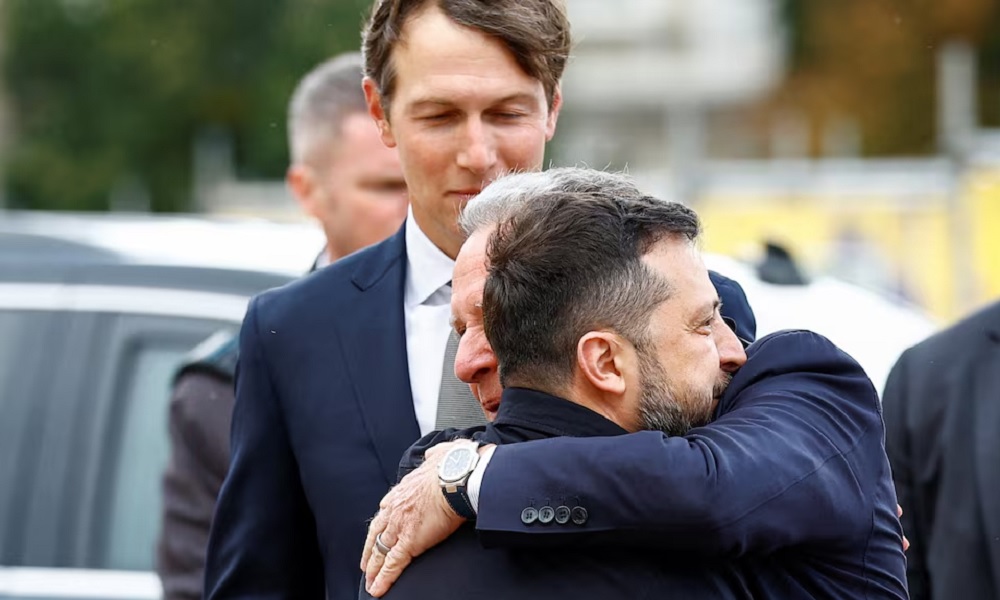
U.S. peace envoys Jared Kushner and Steve Witkoff met with Ukrainian President Volodymyr Zelenskiy in Kyiv on Sunday as the Trump administration renewed its push to end Russia’s four-and-a-half-year war in Ukraine.
Kushner and Witkoff travelled from Moscow, where they held three hours of talks with Russian President Vladimir Putin on Saturday but did not appear to secure a breakthrough in the conflict, Reuters reported.
Previous rounds of U.S.-mediated peace talks encouraged by President Donald Trump, who campaigned on a promise to quickly end the war, have yielded few results. He suggested on Friday that the U.S. had a fresh proposal though he did not elaborate.
Kremlin aide Yuri Ushakov described Saturday’s meeting as “highly useful”, while a White House official told Reuters that next steps would be announced in the coming weeks.
The two envoys met Zelenskiy and other top Ukrainian officials in central Kyiv.
Zelenskiy, who believes Washington will be key to any peace deal, has said a window of opportunity to make peace exists before the U.S. begins focusing on its next presidential election.
After the first round of talks between Ukrainian and U.S. negotiators that lasted about three hours, the U.S. envoys said that they were looking forward to making more progress.
“Substantive, important, and we are very encouraged,” Witkoff told reporters after the talks, which also included a working lunch.
Zelenskiy said that more talks, which would also include European representatives, were planned later on Sunday. British, French and German national security advisers were in Kyiv on Sunday.
“Security guarantees are needed. A dignified post-war peace is needed. Our proposals have been drawn up,” Zelenskiy said as his negotiating team was preparing to meet U.S. envoys.
CAUTIOUS OPTIMISM ON THE STREETS OF KYIV
Witkoff and Kushner, Trump’s son-in-law, have visited Moscow several times in their roles as peace envoys. But Sunday is their first visit to Kyiv in their capacity as U.S. negotiators.
Their visit has long been sought by Ukraine’s leadership, and on the streets of Kyiv, which has been bombarded heavily in recent weeks, some residents were hopeful.
“The issue can be solved in the blink of an eye. We want peace. I’ve fought myself, so I know what war is like. We need peace, because there’s no other way,” said military veteran Stepan Yermak.
In previous talks, the sides have remained far apart on key issues, including the future of the eastern Ukrainian region of Donbas. Russia has demanded Ukraine’s withdrawal from an entrenched belt of towns that it still controls there, but Kyiv has refused, reasoning that it can still hold on.
For Ukraine, hard security guarantees from its European allies and the U.S. are crucial to deterring Russia from invading again.
“We need an agreement that will never be broken,” said Svitlana Kurylenko, a 19-year-old cafe worker.
“Just leave Ukraine alone and let people live in peace.”
TEMPORARY HALT IN STRIKES
Though the front lines of the ground war remain largely static, both Russian and Ukrainian forces have intensified long-range air strikes in recent weeks.
Russia has pounded the Ukrainian capital day and night with missiles and drones for the past two weeks, including an attack on Friday on the headquarters of the SBU security service.
The Kremlin has said it would pause strikes on Kyiv until Monday, while Zelenskiy has said Ukraine would also halt strikes on Moscow.
There was no let-up in fighting along the 1,200-km (750-mile) front, however, and Russia bombarded other Ukrainian cities on Saturday.
Ukraine has inflicted damaging hits throughout the summer on Russian refineries, oil terminals and the warehouses of online retailer Wildberries, in an attempt to raise the cost to Moscow of continuing the war.
Ukraine said on Sunday it had struck the Ryazan oil refinery, around 480 km (300 miles) inside Russia, overnight, causing a fire.







World
Governments warn citizens over security risks in France after riots
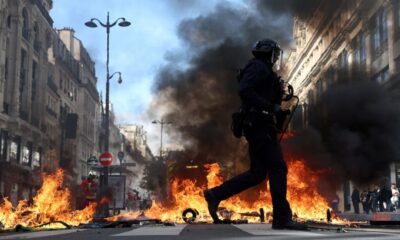
The unrest on Saturday saw clashes between protesters and police, looting at shops and a town hall set on fire, prompting several countries to update their travel advisories.
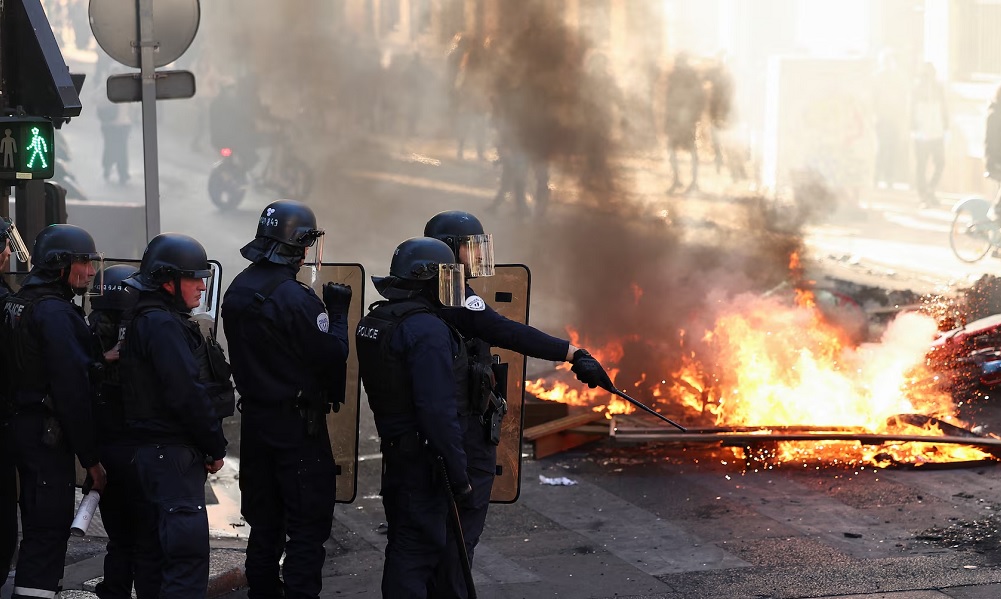
Governments across Europe and Asia have warned their citizens to exercise caution in France following violent protests over the rising cost of living and declining public services that erupted into riots over the weekend.
The unrest on Saturday saw clashes between protesters and police, looting at shops and a town hall set on fire, prompting several countries to update their travel advisories.
Italy urged its citizens in France to avoid large crowds and exercise extreme caution. Its foreign ministry also advised travellers to register their presence through an official website or mobile application to help authorities locate them if necessary.
Germany warned that further riots could occur in the coming days and urged its nationals to follow instructions from local police. It also cautioned that people could face fines or claims for damages if they failed to leave unauthorised demonstrations when ordered to do so.
The Czech Republic advised its citizens to stay away from demonstrations, marches and public gatherings, citing a deterioration in the security situation, the Czech news agency CTK reported.
Poland similarly urged visitors to avoid areas where demonstrations were taking place, although it made no changes to its overall assessment of France as a travel destination.
The Netherlands has also advised travellers to avoid protests, according to its travel guidance, last updated on October 7.
Denmark, Sweden, Finland and Norway issued similar warnings, urging their citizens in France to avoid demonstrations and follow instructions from local authorities.
Outside Europe, Malaysia’s Foreign Ministry said it was monitoring the demonstrations. While travel to France remained unrestricted, it advised Malaysians to consider postponing non-essential trips until the situation improved.
Malaysia’s embassy in Paris also urged citizens in France to remain vigilant and exercise caution.
The warnings reflect growing concern among foreign governments over the potential for further violence as France faces public anger over living costs and pressure on public services. Authorities have urged visitors and residents to monitor local developments and follow police instructions.
World
Violent protests spread across Europe as Albanian PM blames ‘foreign hand’
Hundreds of thousands of people took to the streets in separate demonstrations over the weekend, with some rallies escalating into looting, arson and confrontations with security forces.
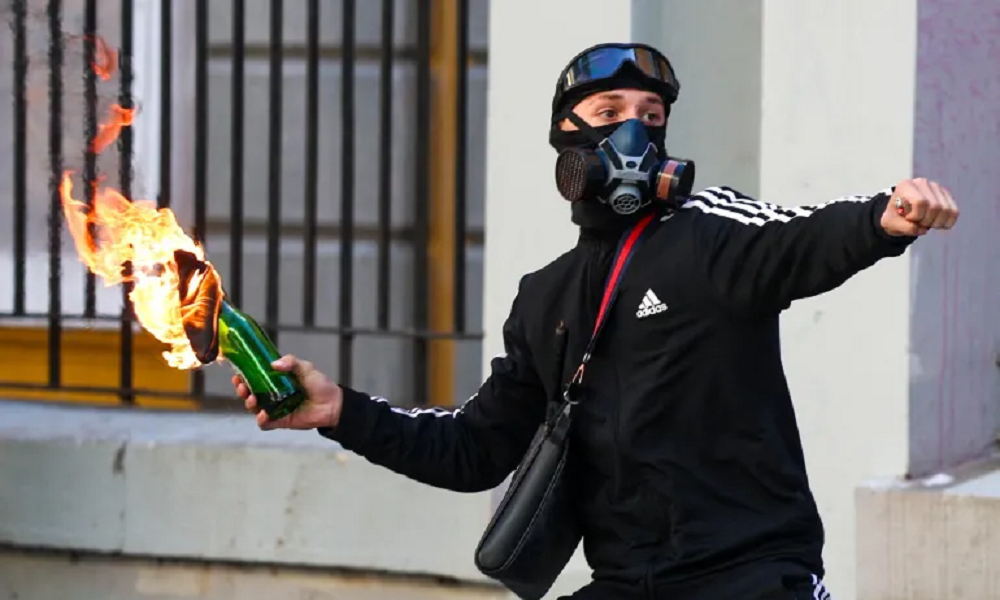
Demonstrations over living costs, housing, education and alleged corruption have triggered clashes with police in several countries across Europe, putting governments under mounting pressure.
Protests and violent clashes have spread this month, with demonstrations in France, Belgium, Italy, Portugal and Albania exposing growing public frustration over economic pressures, education and government accountability.
Hundreds of thousands of people took to the streets in separate demonstrations over the weekend, with some rallies escalating into looting, arson and confrontations with security forces.
In Albania, Prime Minister Edi Rama accused unnamed foreign forces of fuelling the unrest, describing the violence as the work of an “outside hand” seeking to destabilise the country and undermine its ambitions to join the European Union.
The accusation comes as thousands of demonstrators in the capital, Tirana, demand Rama’s resignation, while protests have also spread to other Albanian cities.
Albania protests escalate
Albania has experienced several days of increasingly violent anti-government demonstrations, with students joining a broader movement against Rama’s government.
Protesters have raised concerns about alleged corruption, university conditions, education costs and unemployment. Opposition to a controversial luxury tourism development along Albania’s southern coastline has also contributed to the wider discontent. The project has been linked to Jared Kushner, the son-in-law of US President Donald Trump.
Clashes in Tirana have seen demonstrators throw stones, fireworks and petrol bombs at police, while government buildings and other property have been damaged by fires and vandalism.
Police have responded with tear gas, water cannons and rubber bullets. Authorities have also reported numerous detentions and injuries among protesters and officers.
Rama has rejected calls to resign, arguing that the violence threatens Albania’s European integration ambitions. He has said the government is prepared to address legitimate student concerns but will not yield to demands made through violence.
His claims of foreign interference have not however been independently established.
France sees widespread unrest
France experienced some of the largest demonstrations, with more than 550,000 people taking part in rallies over the weekend.
What began as demonstrations involving students broadened into protests over the cost of living and wider social grievances. Violence erupted in several cities on Saturday, with masked groups targeting shops, supermarkets and public buildings.
French Prime Minister Sébastien Lecornu said more than 1,200 people had been arrested and 150 police officers injured. In Limoges, a fire largely destroyed the historic town hall, while other municipal buildings and businesses were vandalised or looted.
President Emmanuel Macron vowed that those responsible for the violence would face prosecution.
Clashes in Belgium and Italy
In Brussels, Belgian police used tear gas and water cannons to disperse demonstrators after accusing some protesters of throwing objects at officers and starting fires. Similar tactics were used in Liège.
The unrest followed weeks of student protests over university registration fees and reflected wider concerns about the affordability of education and everyday expenses.
In Milan, Italy, a march against war and rising living costs descended into clashes as masked protesters threw stones and paving blocks at riot police, looted shops and set fire to barricades.
Police used tear gas and water cannons to clear crowds from the city centre. At least two officers were injured and about 50 demonstrators were detained, according to Italian news agency LaPresse.
Prime Minister Giorgia Meloni condemned the violence, while Milan Mayor Giuseppe Sala said protesters’ concerns were understandable but that attacks on police and damage to public property were unacceptable.
Clashes were also reported in Bologna.
Housing and wages drive protests in Portugal
In Lisbon, tens of thousands of people marched on Saturday against rising living costs, low wages and the difficulty of finding affordable housing.
House prices in Portugal have more than doubled since 2017, while rents for new leases have risen sharply, intensifying pressure on households in major cities.
Demonstrators called for higher wages and pensions and action to address housing and fuel costs. Some erected tents in central Lisbon to highlight the housing crisis.
The Portuguese government has faced criticism from protesters who accuse political leaders of being disconnected from the financial pressures experienced by ordinary citizens.
Spain housing protests turn violent
Spain also faced its own protests earlier this month when violence erupted during housing protests in Spain on October 3, with clashes reported in Valencia and Barcelona.
Demonstrators protested soaring rents, evictions and the growing difficulty of accessing affordable housing.
Police made arrests as unrest escalated, with officers injured during confrontations. The demonstrations reflect mounting public anger over Spain’s housing crisis and growing pressure on Prime Minister Pedro Sánchez’s government to introduce lasting solutions.
Wider warning for European governments
Although the demonstrations are believed to not be part of a single coordinated movement, analysts say they reflect overlapping concerns about living standards, education, housing and the prospects facing younger generations.
Alberto Alemanno, a professor of European Union law and policy at HEC Paris Business School, told Al Jazeera however that France appeared to be at the centre of a wider wave of unrest, with signs of mobilisation emerging elsewhere in Europe.
He suggested that further demonstrations could take place in the coming weeks, including in Germany, Greece and Austria.
Reinout Van Zandycke, a communications expert in Belgium, warned last week that foreign interference could be involved in TikTok calls encouraging people to protest in France and Belgium on October 17. His concern focused on the online mobilisation and the possibility of manipulation, rather than proof that the protests were centrally organised.
The unrest presents a challenge for governments already facing public pressure over economic conditions and political accountability. In Albania, the dispute has also become entangled with the country’s ambition to join the European Union.
Whether the demonstrations lead to policy changes or further confrontation remains uncertain. However, the spread of unrest underlines the pressure facing European governments as protesters demand action on living costs, education, housing and corruption.
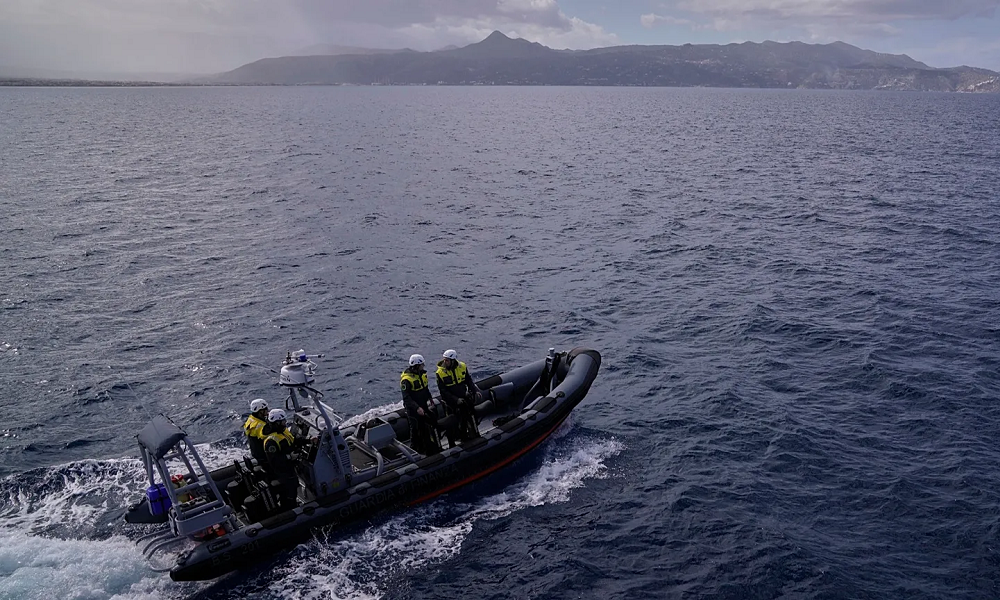
Twelve migrants died Monday attempting to cross the Aegean Sea, including six people whose bodies were found after their boat collided with a police vessel, authorities said.
A baby and four women were among six people who died off the island of Lesbos on Monday following the collision, a coast guard official told AFP.
The other six dead – five men and a woman – were on a small boat that capsized off the island of Samos, the coast guard added. Another 14 people from the boat, one of them a presumed Iranian organiser, were rescued.
The coast guard official said that in the incident off Lesbos, “a speed boat carrying migrants collided with the port side of a police patrol vessel”. The official said eight people were rescued.
The nationalities of the deceased have not yet been released.
The Aegean is a much-used route for migrants crossing from Turkey and hoping to reach Europe. There have been many deaths.
One person died and 25 remained missing after a boat filled with migrants sank off the island of Gavdos, near Crete in September. – AFP (edited)


Tahawol: Doha meeting and Afghanistan’s political and economic future discussed

Saar: Concerns over expansion of conflict between Iran and US discussed

Afghanistan, world and Asian canoeing federations hold online meeting

Uzbekistan, Norway discuss Afghanistan and regional security in Oslo

Governments warn citizens over security risks in France after riots

Cricket Bonanza: Afghanistan set for packed international schedule

Afghanistan says 28 killed, 32 captured in Nuristan operation

Silk Road highway in Wakhan corridor now reaches the China border

CNN, MS NOW and Politico sue Trump, challenging White House ban

Afghanistan on climate front line as Kabul faces groundwater warning
Tahawol: Doha meeting and Afghanistan’s political and economic future discussed
Saar: Concerns over expansion of conflict between Iran and US discussed
Governments warn citizens over security risks in France after riots

Tahawol: Iran’s reaction to Pakistan’s mediation discussed

Saar: Review of SCO meeting in Tajikistan
-

 Sport4 days ago
Afghanistan reach Brazil futsal tournament final after beating Cape Verde 4-2
-

 Regional5 days ago
Trump says US may strike Iran’s ‘Pickaxe Mountain’ nuclear facility
-
 World2 days ago
Violent protests spread across Europe as Albanian PM blames ‘foreign hand’
-
 Latest News5 days ago
Afghanistan’s hunger crisis deepens as 16 million face food insecurity ahead of winter
-

 Sport3 days ago
Afghanistan finish runners-up after 6-0 defeat to Brazil in futsal final
-

 Latest News4 days ago
Hegseth says only a few NATO allies were involved in fighting in Afghanistan
-
 World4 days ago
France rocked by nationwide clashes, looting and fires
-

 Tahawol4 days ago
Tahawol: Russian economic delegation’s visit to Kabul