
Business
IEA approves national budget for solar year 1401

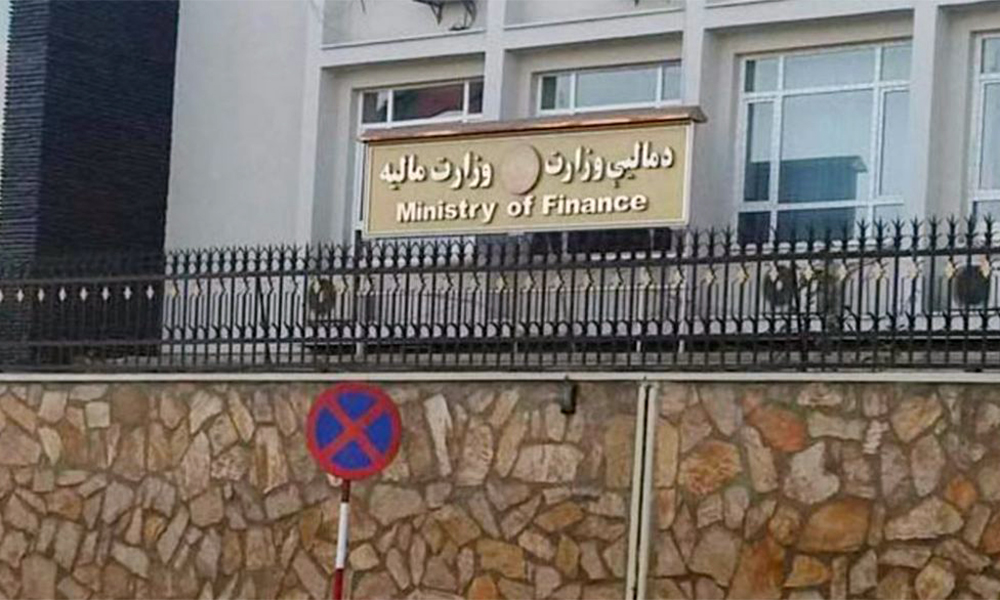
Inamullah Samangani, deputy spokesman for the Islamic Emirate of Afghanistan, said Saturday that this year’s budget has been approved.
He said the budget, unlike in previous years, is entirely made up of domestic revenue and without any foreign financial support.
According to the ministry of finance, the budget was approved by Council of Ministers of the IEA and IEA’s Supreme Leader, Haibatullah Akhundzada.
The budget for fiscal year 1401 is 231 billion Afghanis (AFN), of which 203 billion is the regular budget and 27.9 billion AFN is the development budget.
Zabihullah Mujahid, the IEA’s spokesman, said in a tweet that 1401 budget is made up entirely of domestic revenue.
The ministry of finance meanwhile added that there is a deficit of 44 billion AFN in the budget. However, the Islamic Emirate of Afghanistan will achieve its goals by the end of the year based on a financial plan.




Business
Afghanistan transports more than 704,000 tonnes of goods by rail in August
The Hairatan railway route handled the largest share, with 464,767 tonnes, followed by Khaf–Herat with 137,687 tonnes, Torghundi with 62,015 tonnes, and Aqina with 39,831 tonnes.

Afghanistan transported more than 704,000 metric tonnes of goods through its railway network in August 2026, the Ministry of Public Works said.
The ministry said 704,300 metric tonnes of petroleum products, non-petroleum goods and other materials were imported and exported through four major railway routes during the month.
The Hairatan railway route handled the largest share, with 464,767 tonnes, followed by Khaf–Herat with 137,687 tonnes, Torghundi with 62,015 tonnes, and Aqina with 39,831 tonnes.
The ministry said the railway network also supported Afghan exports during the month, including 3,751 tonnes of carbonated beverages shipped abroad.
According to the ministry, expanding rail transportation and exports could contribute to job creation, higher national revenues and greater economic stability and self-sufficiency.
The ministry added that the Islamic Emirate is working to improve trade conditions and expand transportation facilities for Afghan traders.
Business
TAPI pipeline nears first gas sales in Afghanistan
Herat Governor Mawlavi Islam Jar recently said construction of the TAPI pipeline in the province is expected to be completed within two months.
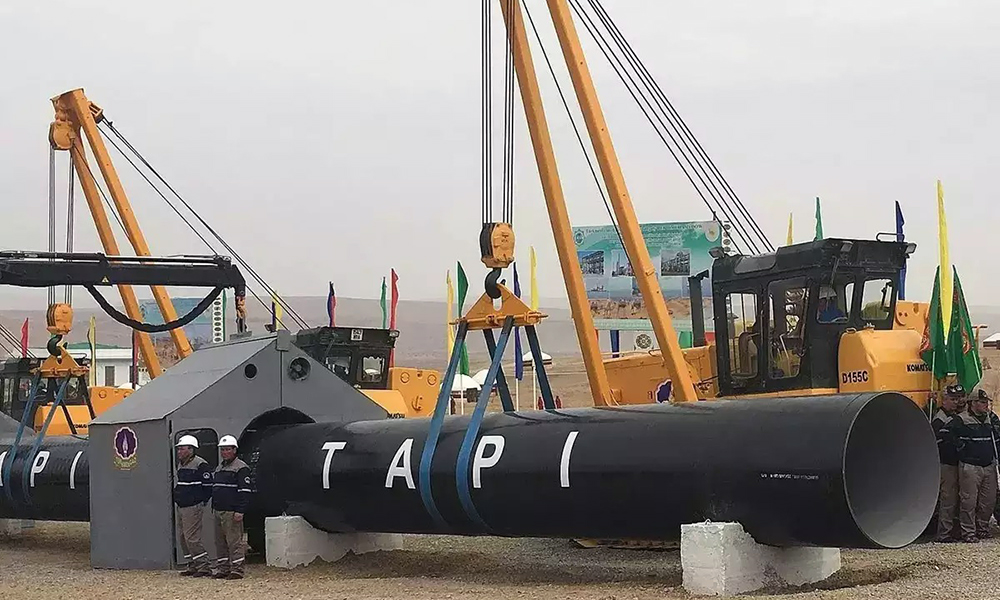
The Turkmenistan-Afghanistan-Pakistan-India (TAPI) gas pipeline is moving closer to its first commercial gas sales in Afghanistan after years of delays, with Herat expected to become the first Afghan market served by the project.
According to the Times of Central Asia, Turkmenistan plans to supply gas to Herat through the TAPI pipeline, while the timeline for extending the project to Pakistan and India remains uncertain.
The report says Turkmengaz and Afghan Gas signed a memorandum on August 10 covering the purchase of gas through TAPI. However, the agreement does not yet specify the price, supply volume or exact date for the start of commercial deliveries.
Afghan and Turkmen officials are also working to develop a gas distribution network in Herat to supply industrial facilities, power plants and households.
Meanwhile, Herat Governor Mawlavi Islam Jar recently said construction of the TAPI pipeline in the province is expected to be completed within two months.
According to the governor, Turkmen officials have completed their work on the project and will hand it over to Herat authorities once the remaining process is finalized.
Jar has also urged residents and factory owners in Herat’s industrial park to make the necessary preparations for the start of gas distribution and pipeline connections.
The TAPI project is designed to transport Turkmenistan’s natural gas through Afghanistan and Pakistan to India, with a planned annual capacity of 33 billion cubic meters.
Business
Afghanistan, Russia discuss special economic zone and expanded trade cooperation
The Russian ambassador also presented a proposal concerning joint-stock companies related to “Stras and Afsutor.”
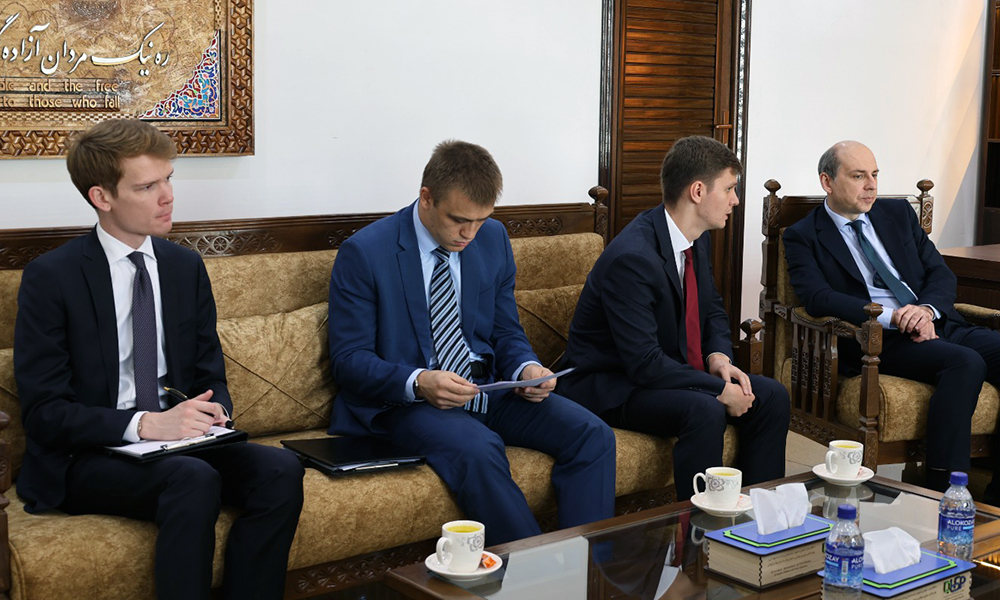
Afghanistan and Russia have discussed plans to expand economic and trade cooperation, including a proposal to establish a special economic zone at the Hairatan border port.
Ahmad Jan Bilal, Director General of State-Owned Enterprises, met with Dmitry Zhirnov, the Russian ambassador to Afghanistan, at his office. Saeedurrahman Mazhari, head of the director general’s office, and Momtazuddin Momtaz, head of legal affairs, also attended the meeting.
During the talks, Zhirnov thanked Bilal for arranging the meeting and proposed the establishment of a special economic zone in Hairatan. He said the zone could provide facilities for the storage, processing and packaging of agricultural products, as well as other economic activities.
The Russian ambassador also presented a proposal concerning joint-stock companies related to “Stras and Afsutor.”
Bilal welcomed the proposal and stressed the importance of establishing an economic zone. He said the General Directorate of State-Owned Enterprises was working to further strengthen and expand the activities of the relevant companies to help increase exports of Afghanistan’s fresh and dried fruits to international markets.
He added that Afghanistan welcomes Russia’s cooperation in various economic sectors and is ready to expand further joint economic and trade partnerships.
Bilal also called for cooperation and agreements on establishing a workshop for repairing Kamaz vehicles in Afghanistan and importing petroleum products from Russia.
At the conclusion of the meeting, the Russian ambassador assured the Afghan side of Russia’s comprehensive cooperation on the issues discussed.


Saar: Discussion on ensuring Afghanistan’s border security

European Parliament to discuss return of Afghan asylum seekers

Afghan soil poses no threat to other countries: Defense Ministry

Mujahid: Afghanistan ‘undoubtedly’ better off without US presence

US chose to stay in Afghanistan instead of eliminating terrorism, says Russian FM

Pakistan’s governance system has ‘collapsed’: Mohsin Naqvi

AFC confirms clubs for 2026/27 competitions; draw set for August 18

Only two days to go before Afghanistan and Ireland begin ODI series

Four mediators struggle to secure lasting Pakistan-Afghanistan ceasefire

Heavy monsoon rains claim lives across India as flooding and landslides continue
Saar: Discussion on ensuring Afghanistan’s border security

Tawsia: Afghanistan’s efforts to boost production and exports disucssed

Tahawol: Fifth anniversary of America’s defeat in Afghanistan discussed

Saar: Ongoing expulsion of Afghans from Iran and Pakistan discussed

Tahawol: Calls for US engagement with the Islamic Emirate discussed
-
 Latest News2 days ago
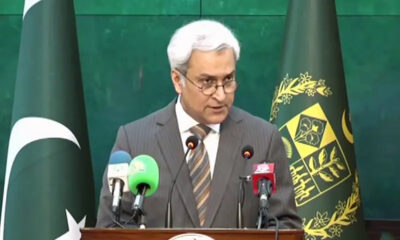
Pakistan open to state-to-state dialogue with Afghanistan on terrorism
-

 Latest News4 days ago
First deportation flight to Haiti arrives as US ends temporary protected status
-

 International Sports4 days ago
Watford face Peterborough in EFL Cup; ATN to bring live action to Afghan fans
-
 Latest News4 days ago
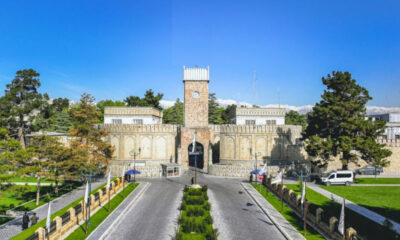
IEA announces new appointments in Badakhshan, Sar-e-Pul and Kandahar
-

 Latest News4 days ago
Germany deports 30 Afghan refugees to Kabul
-

 World5 days ago
Israel’s Netanyahu says Iran tried to kill one of his sons
-
 Regional5 days ago
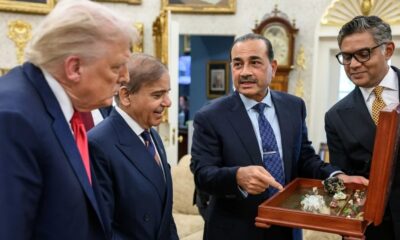
Pakistan’s Munir spoke to Trump ahead of Tehran visit, sources say
-
 Climate Change4 days ago
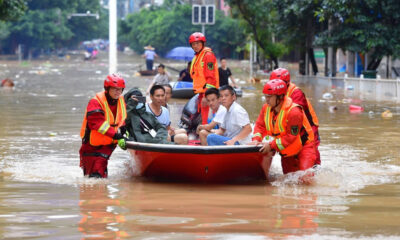
China evacuates thousands as Typhoon Narra brings torrential rain