
Latest News
Former President Dr. Najibullah Remembered on 20th Death Anniversary

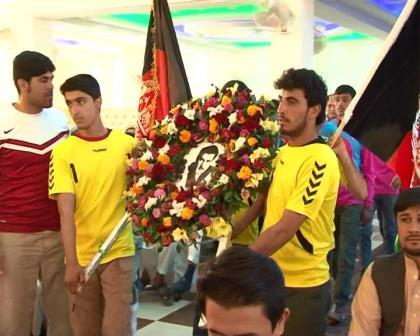
 A number of supporters paid tribute to former Afghan president, Dr Najibullah on the occasion of his 20th death anniversary on Monday and recalled his services for the wellbeing of his people.
Speakers at a gathering have declared that Dr. Najibullah has seek a regional peace process.
“The killing of Dr Najib was a black chapter of the history, as he worked for the rights and unity of Pakhtuns throughout his life. For this he would be remembered for ever,” one of the speaker said.
A number of parliament representatives who also presented at the gathering noted that Afghanistan is once again in a crucial historical step and some circles are attempting to create crisis by fueling ethnic, regional and linguistic issues.
Mohammad Najibullah, born 1947, in Gardiz province of Afghanistan, died September 27, 1996 in Kabul.
Dr. Najibullah began studying medicine at Kabul University in 1964 and received his degree in 1975, but he never practiced medicine.
He joined the Banner (“Parcham”) faction of the People’s Democratic Party of Afghanistan (PDPA) in 1965, and he was twice imprisoned for political activities.
In 1978 the PDPA staged a successful coup, but the People’s (“Khalq”) faction soon gained supremacy over the Banner faction.
Dr. Najib was named ambassador to Iran in 1978 but was fired within months after being accused of plotting to overthrow the regime of Hafizullah Amin.
He went into exile in eastern Europe until the U.S.S.R. intervened in 1979 and supported a Parcham-dominated government.
Najibullah was made head of the secret police and became known for his brutality and ruthlessness. His methods proved invaluable to the regime in view of escalating guerrilla warfare of the Muslim mujahideen, but as the war grew in intensity, the Soviet Union withdrew.
Dr. Najib, who replaced Babrak Karmal as president in 1986, attempted to gain support by relaxing Karmal’s strict control, but he was widely despised and was finally forced from office by the mujahideen rebels and mutinous groups within his own military in 1992
He took refuge in a United Nations compound, where he was sheltered for the next four years. Factional fighting continued, and when the Taliban militia took over the capital, Kabul, in 1996, they summarily executed Najibullah.

Latest News
UNAMA voices concern over reported detention of women in Herat
UNAMA said it had received reports of multiple arrests and detentions of women in Herat linked to alleged violations of dress regulations and was closely monitoring the situation.

The United Nations Assistance Mission in Afghanistan (UNAMA) has expressed concern over reports that several women in Herat province have been detained for allegedly failing to comply with dress requirements, warning that the incidents raise serious human rights concerns.
In a statement issued on Sunday, UNAMA said it had received reports of multiple arrests and detentions of women in Herat linked to alleged violations of dress regulations and was closely monitoring the situation.
“UNAMA is concerned over multiple arrests and detentions of women in Herat for alleged non-compliance with dress requirements, which raises serious human rights concerns,” the mission said.
The UN mission reiterated that freedom of movement is a fundamental right and stressed that both women and men are entitled to equal protection under the law.
The statement comes as the rights of women and girls in Afghanistan continue to be a key issue in discussions between the Islamic Emirate and the international community. International organizations have repeatedly called for the protection of fundamental rights, while the Islamic Emirate maintains that women’s rights are safeguarded in accordance with Sharia law.
Authorities have not yet publicly responded to UNAMA’s statement.
Latest News
IEA’s Supreme Leader says implementation of Sharia depends on revival of religious education
In his address, the Islamic Emirate leader further urged officials to remain vigilant in administrative, political, economic and military affairs.
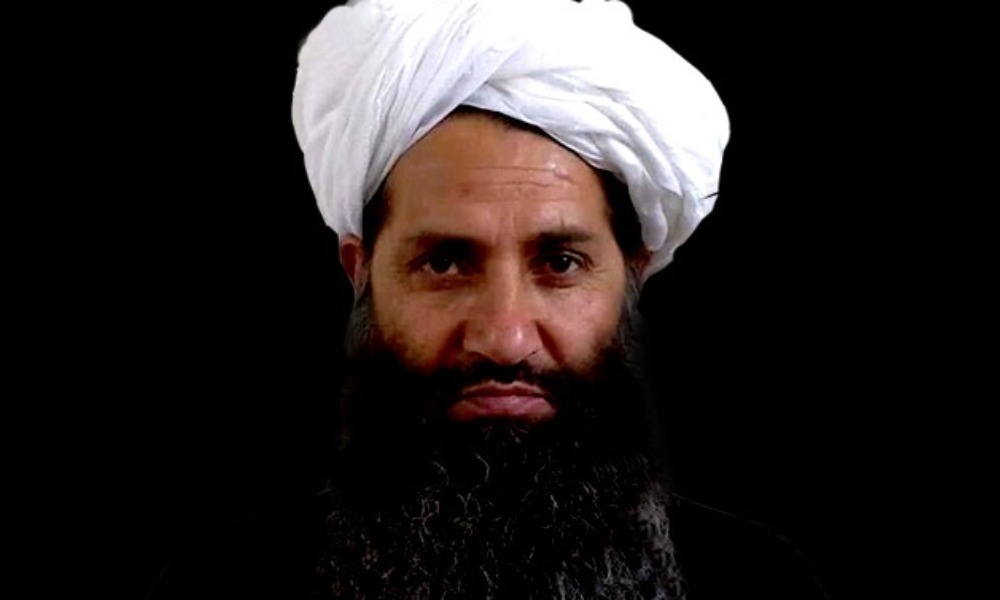
Sheikh Hibatullah Akhundzada, the supreme leader of the Islamic Emirate, has emphasized the importance of religious education, saying that the implementation of Sharia and the reform of society are only possible through the revival and strengthening of Islamic sciences.
The remarks came during a meeting with administrators of jihadist religious schools, teachers, officials responsible for reviewing religious publications, orphanage administrators and a number of religious scholars, according to a statement released by the Islamic Emirate.
Akhundzada described religious scholars as the heirs of the prophets and said they carry the responsibility of preserving the faith, guiding society and raising public awareness. He urged scholars to play a greater role in educating people and promoting Islamic values through teaching, preaching and religious outreach.
He also called on officials and educators to focus on the intellectual and moral development of students, strengthen their religious knowledge and beliefs, and encourage study and learning within religious institutions.
In his address, the Islamic Emirate leader further urged officials to remain vigilant in administrative, political, economic and military affairs, warning against negligence and stressing the need for stronger cooperation and mutual trust among state institutions.
Latest News
UN Security Council to review Afghanistan situation as UNAMA mandate nears expiry
According to the Security Council, Afghanistan remains one of the world’s most severe humanitarian crises, with an estimated 21.9 million people requiring assistance this year.
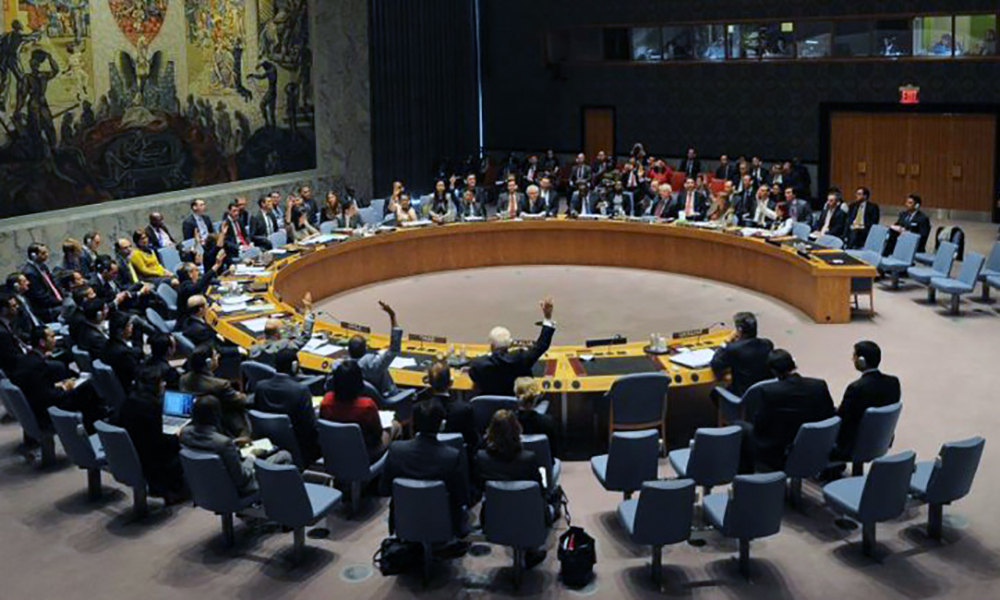
The United Nations Security Council will hold its quarterly meeting on Afghanistan on Monday, with members set to assess recent developments in the country and discuss the future of international engagement.
During the session, the head of the United Nations Assistance Mission in Afghanistan (UNAMA) is expected to present the UN Secretary-General’s latest report, outlining political, humanitarian and social developments over the past three months.
The discussions are expected to focus on key issues including the humanitarian situation, political developments, and the rights of women and girls, particularly access to education.
According to the Security Council, Afghanistan remains one of the world’s most severe humanitarian crises, with an estimated 21.9 million people requiring assistance this year.
While council members broadly support an Afghanistan free of terrorism, governed inclusively and committed to international obligations, differences remain over how best to achieve those goals.
Analysts say the meeting could offer important indications of the Security Council’s assessment of Afghanistan and the international community’s future approach toward the country. The talks are also expected to address UNAMA’s role in facilitating engagement between Afghanistan and the wider international community.
Officials of the Islamic Emirate have repeatedly urged the United Nations and other international actors to present what they describe as a balanced and impartial picture of Afghanistan, while acknowledging developments on the ground.
The meeting comes ahead of the expiration of UNAMA’s current mandate on June 16. The Security Council is expected to decide on the mission’s extension the same day.
UNAMA remains the United Nations’ primary presence in Afghanistan, coordinating humanitarian assistance, monitoring human rights issues and supporting diplomatic efforts aimed at fostering dialogue between Afghanistan and the international community.


SAAR: UN Security Council Holds Quarterly Meeting on Afghanistan

UNAMA voices concern over reported detention of women in Herat

IEA’s Supreme Leader says implementation of Sharia depends on revival of religious education

UN Security Council to review Afghanistan situation as UNAMA mandate nears expiry

Iran receives 417 million cubic meters of water from Afghanistan this year

Afghanistan signs $46 million deal to develop standard laboratory complexes

Large blast near Beit Shemesh part of pre-planned test: Israeli defense firm

Trump returns from China with stability but little progress

Afghanistan announce squad for India series

Afghanistan, Russia sign military cooperation agreement
SAAR: UN Security Council Holds Quarterly Meeting on Afghanistan

Tahawol: Impact of Middle East crisis on aid transfers to Afghanistan

Saar: Calls to strengthen economic and trade cooperation discussed

Tawsia: Signing of $20 million Herat salt mining deal discussed

Tahawol: Discussion on fear of internal disputes in Iran
-
 Business4 days ago
Afghanistan’s trade with Central Asia records sharp growth
-
 Sport3 days ago
Gaikwad set to replace injured Kohli for Afghanistan ODI Series
-

 Latest News5 days ago
Three Afghans among four farmworkers burned alive in Italy; two Pakistanis arrested
-
 Sport4 days ago
Afghanistan name squad for A-team tri-series in Sri Lanka
-
 Business4 days ago
Afghanistan highlights strategic connectivity role at Termez Dialogue
-
 Latest News4 days ago
Kohli ruled out of Afghanistan ODI series with hamstring injury
-

 Latest News5 days ago
Rubio says at least five countries willing to accept stranded Afghans in Qatar
-

 International Sports3 days ago
Eight Goalkeepers Set to Shine at the 2026 FIFA World Cup