
World
Trump launches gold card program for expedited visas with a $1 million price tag

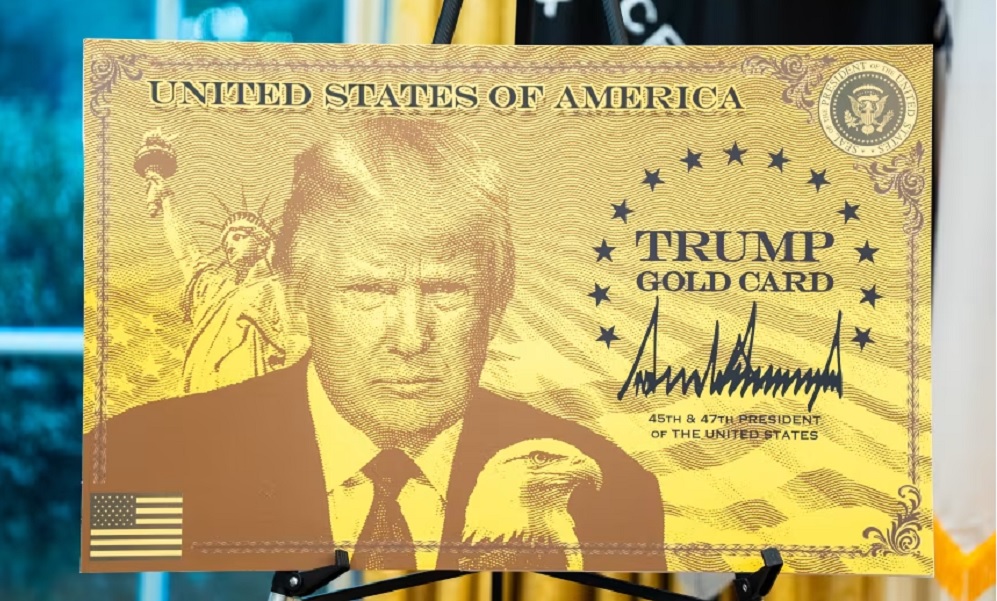
President Donald Trump’s administration officially launched his “Trump Gold Card” visa program on Wednesday to provide a pathway, with a steep price, for non-U.S. citizens to get expedited permission to live in the United States.
The website Trumpcard.gov, complete with an “apply now” button, allows interested applicants to pay a $15,000 fee to the Department of Homeland Security for speedy processing, Reuters reported.
After going through a background check or vetting process, applicants must then make a “contribution” — the website also calls it a “gift” — of $1 million to get the visa, similar to a “Green Card,” which allows them to live and work in the United States.
“Basically it’s a Green Card, but much better. Much more powerful, a much stronger path,” Trump told reporters at the White House. “A path is a big deal. Have to be great people.”
Commerce Secretary Howard Lutnick said some 10,000 people have already signed up for the gold card during a pre-registration period and he expected many more to do so. “I would expect over time that we’d sell, you know, thousands of these cards and raise, you know, billions, billions of dollars,” Lutnick told Reuters in a brief interview.
Lutnick said the gold card program would bring people into the United States who would benefit the economy. He compared that to “average” Green Card holders, whom he said earned less money than average Americans and were more likely to be on or have family members on public assistance. He did not provide evidence for that assertion.
Trump’s administration has pursued a broad crackdown on immigration, deporting hundreds of thousands of people who were in the country illegally and also taking measures to discourage legal immigration.
The gold card program is the Trump version of a counter balance to that, designed to make money for the U.S. Treasury in the same way the president, a former New York businessman and reality television host, has said his tariff program has successfully done.
Lutnick noted that there was also a corporate version of the gold card that allowed companies to get expedited visas for employees they wanted to work in the United States, for a $2 million contribution per employee.






Officials in U.S. President Donald Trump’s administration defended on Sunday the fatal shooting of a U.S. citizen by immigration agents in Minneapolis, even as video evidence contradicted their version of events and as tensions grew between local law enforcement and federal officers.
As residents visited a makeshift shrine of flowers and candles in frigid temperatures and snow to mark Saturday’s fatal shooting of Alex Pretti, Trump administration officials stated that Pretti assaulted officers, compelling them to fire in self-defense. That account was at odds with videos recorded by bystanders, Reuters reported.
Pretti is the second American to be fatally shot by federal immigration officers this month in Minneapolis, where Trump, a Republican, has deployed thousands of armed and masked agents in a deportation effort with little precedent.
Minnesota Governor Tim Walz, a Democrat, again called on Trump to pull federal agents out of the state, which has asked a federal judge to restrain what it says are unconstitutional excesses in Trump’s surge.
“The victims are Border Patrol agents,” Gregory Bovino, a senior Border Patrol official, told CNN’s “State of the Union” program.
That official line, echoed by Homeland Security Secretary Kristi Noem and other members of the administration, drew outrage from local Democratic leaders and law enforcement and Democrats in the U.S. Congress, who pointed to the bystander videos that show all Pretti had in his hands was a cellphone before agents grappled him to the ground and ultimately shot him at close range.
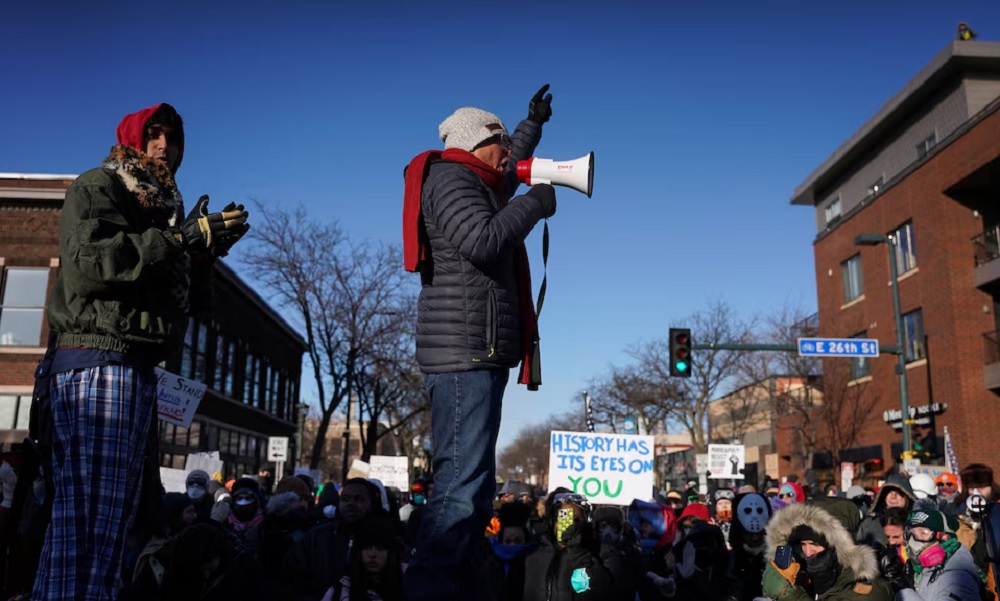
Federal agents over the past few weeks have been met by countless angry residents protesting in the city’s icy streets, some of them blowing whistles. Thousands of people again filled the streets of Minneapolis on Sunday to protest against the surge in U.S. Immigration and Customs Enforcement agents, chanting and waving signs saying: “ICE OUT!”
HOLDING A PHONE, NOT A GUN
Videos of Saturday’s killing verified by Reuters show Pretti, 37, holding a phone in his hand, not a gun, as he tries to help other protesters who had been pushed to the ground by agents.
Pretti can be seen filming while a federal agent pushes away one woman and shoves another woman to the ground. Pretti moves between the agent and the women, then raises his left arm to shield himself as the agent pepper sprays him.
Several agents then take hold of Pretti, who struggles with them, and force him onto his hands and knees. As the agents pin Pretti down, someone shouts what sounds like a warning about a gun.
Video footage then appears to show one of the agents removing a handgun from Pretti’s waistband area and stepping away from the group with it.
Moments later, an officer points his gun at Pretti’s back and fires four shots in quick succession. More shots are heard as another agent appears to fire at Pretti.
Darius Reeves, the former head of ICE’s field office in Baltimore, told Reuters that federal agents’ apparent lack of communication was troubling. “It’s clear no one is communicating to me, based on my observation of how that team responded,” Reeves said.
Minnesota officials say Pretti had a valid state permit to carry a concealed gun in public, which the U.S. Supreme Court ruled was a constitutional right in 2022.
‘VIDEOS SPEAK FOR THEMSELVES’
Brian O’Hara, the Minneapolis police chief, told the CBS “Face the Nation” program that “the videos speak for themselves,” calling the Trump administration’s version of events deeply disturbing. He said he had seen no evidence that Pretti brandished a gun.
Tensions in the city were already running high after a federal immigration agent fatally shot U.S. citizen Renee Good on January 7 after approaching her in her parked vehicle. Trump officials said she was trying to ram the agent with the vehicle but other observers said bystander video suggests she was attempting to steer away from the officer who shot her.
State and local law enforcement are investigating whether the agent who killed Good broke any Minnesota laws. The U.S. Justice Department withdrew its cooperation from that probe, and at least a dozen federal prosecutors said they were resigning over the Justice Department’s handling of Good’s killing.
At Minnesota’s request, a federal judge issued a temporary order on Saturday night forbidding the Trump administration from destroying or altering evidence related to Pretti’s killing.
Chief executives of some of Minnesota’s largest companies, including Target, Cargill and Best Buy, published a letter calling for the “immediate de-escalation of tensions and for state, local and federal officials to work together to find real solutions.”
In separate statements, former U.S. Presidents Barack Obama and Bill Clinton decried the killings of Good and Pretti, with Clinton accusing the Trump administration of lying and Obama saying American values are under assault.
“This has to stop,” Barack and Michelle Obama said.
Pretti worked as an intensive care nurse at a Veterans Affairs hospital. On Sunday, more than 200 healthcare workers gathered at the site of his killing, leaving flowers and other tributes. One woman in medical scrubs, when asked what brought her out, said she had worked with Pretti and began to sob.
“He was caring and he was kind,” she said, asking not to be named for fear of retribution from the federal government. “None of this makes any sense.”
At a Sunday press conference, Minnesota Attorney General Keith Ellison recounted a story that he said was from his 31-year-old son, a nurse in Minnesota’s healthcare system.
“When he was at work today and last night, he said, ‘Look, our colleagues were crying and in tears, and they took this hit to one of their own very personally,'” Ellison told reporters.
Trump has defended the operations as necessary to reduce crime and enforce immigration laws.
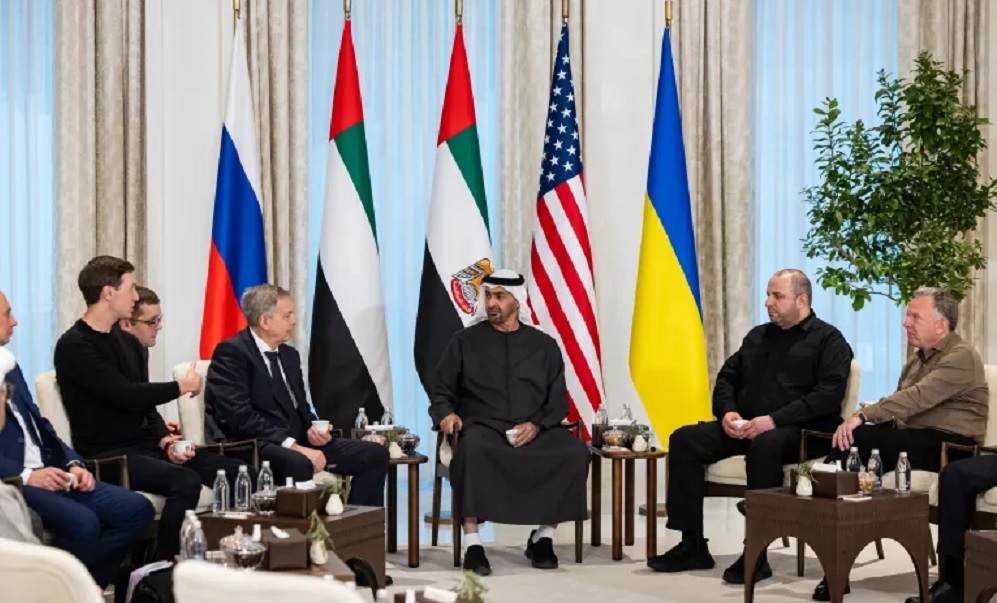
Ukrainian and Russian negotiators met in Abu Dhabi on Friday to tackle the vital issue of territory, with no sign of a compromise, as Russian airstrikes plunged Ukraine into its worst energy crisis of the nearly four-year war.
Kyiv is under mounting U.S. pressure to reach a peace deal in the war triggered by Russia’s full-scale invasion in February 2022, with Moscow demanding Kyiv cede its entire eastern industrial area of Donbas before it stops fighting, Reuters reported.
Ukrainian President Volodymyr Zelenskiy said the territorial dispute was a central issue for the tripartite talks, including Russian, Ukrainian and U.S. officials, which were scheduled to conclude on Saturday.
“The most important thing is that Russia should be ready to end this war, which it started,” Zelenskiy said in a statement on the Telegram app, adding he was in regular contact with the Ukrainian negotiators, but it was too early to draw conclusions from Friday’s talks.
“We’ll see how the conversation goes tomorrow and what the outcome will be.”
Rustem Umerov, the secretary of Ukraine’s National Security and Defence Council and the head of its delegation, said in a statement the talks had discussed parameters for ending the war and the “further logic of the negotiation process.”
The negotiations come a day after Zelenskiy met with U.S. President Donald Trump at the World Economic Forum in Davos, Switzerland.
Zelenskiy said on Friday that a deal on U.S. security guarantees for Ukraine was ready, and that he was only waiting on Trump for a specific date and place to sign it.
Ukraine has sought robust security guarantees from Western allies in the event of a peace deal to prevent Russia, which has shown little interest in ending the war, from invading again.
RUSSIA STEPS UP ATTACKS ON POWER INFRASTRUCTURE
The tripartite talks, brokered by the U.S., are unfolding against a backdrop of intensified Russian strikes on Ukraine’s energy system that have cut power and heating to major cities such as Kyiv, as temperatures dip well below freezing.
The head of Ukraine’s top private power producer, Maxim Timchenko, told Reuters on Friday the situation was nearing a “humanitarian catastrophe” and that Ukraine needs a ceasefire that halts attacks on energy infrastructure.
Kyiv’s energy minister said on Thursday that Ukraine’s power grid had endured its most difficult day since a widespread blackout in November 2022, when Russia began bombing energy infrastructure.
Russia says it wants a diplomatic solution but will keep working to achieve its goals by military means as long as a negotiated solution remains elusive.
Russian President Vladimir Putin’s demand that Ukraine surrender the 20% it still holds of the Donetsk region of the Donbas – about 5,000 sq km (1,900 sq miles) – has proven a major stumbling block to a breakthrough deal.
Zelenskiy refuses to give up land that Russia has not been able to capture in four years of grinding, attritional warfare. Polls show little appetite among Ukrainians for territorial concessions.
Kremlin spokesman Dmitry Peskov said on Friday that Russia’s insistence on Ukraine yielding all of Donbas was “a very important condition.”
A source close to the Kremlin told Reuters that Moscow considers an “Anchorage formula” – which Russia says was agreed between Trump and Putin at a summit in Alaska last August – would hand Russia control of all of Donbas and freeze the front lines elsewhere in Ukraine’s east and south.
Donetsk is one of four Ukrainian regions Moscow said in 2022 it was annexing after referendums rejected by Kyiv and Western nations as bogus. Most countries recognise Donetsk as part of Ukraine.
MOSCOW WANTS USE OF FROZEN ASSETS
Russia has also floated the idea of using the bulk of nearly $5 billion of Russian assets frozen in the United States to fund a recovery of Russian-occupied territory inside Ukraine. Ukraine, backed by European allies, demands that Russia pay it reparations.
Asked about Russia’s idea, Zelenskiy dismissed it as “nonsense.”
Zelenskiy said on Thursday in Davos that the Abu Dhabi talks would be the first trilateral meetings involving Ukrainian and Russian envoys and U.S. mediators since the war began.
Last year, Russian and Ukrainian delegations had their first face-to-face meeting since 2022 when they met in Istanbul. A top Ukrainian military intelligence officer also had talks with U.S. and Russian delegations in Abu Dhabi in November.
World
Trump’s ‘Board of Peace’ takes shape amid global debate
Some European governments and humanitarian organisations have questioned the board’s mandate, warning it could undermine the role of the UN and other established multilateral frameworks.
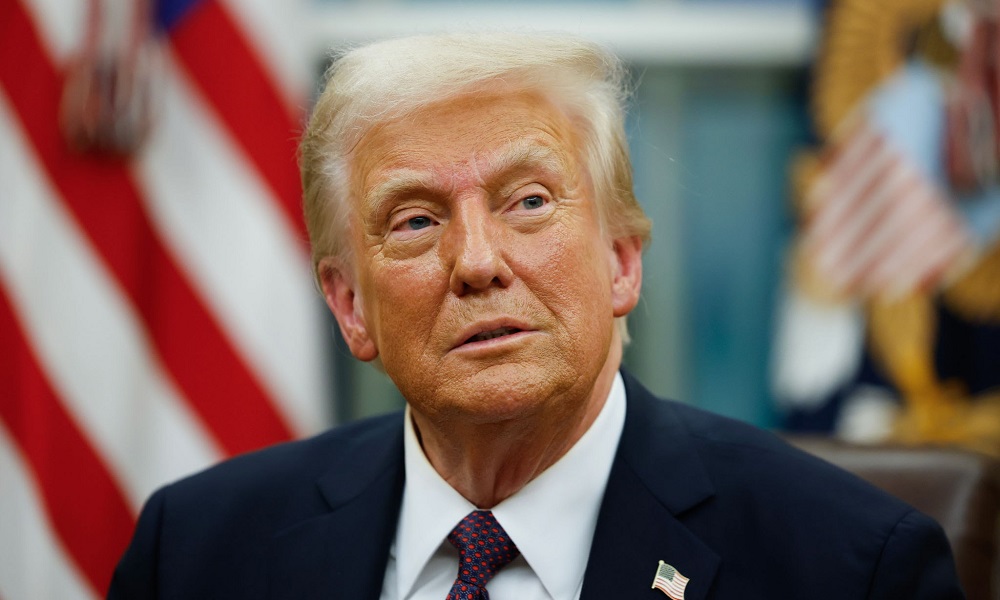
Fresh details have emerged around US President Donald Trump’s proposed “Board of Peace,” an initiative he says is aimed at advancing conflict resolution and post-war reconstruction in some of the world’s most volatile regions, including Gaza, even as the plan continues to draw mixed reactions internationally.
The initiative, first unveiled earlier this month, was formally outlined on the sidelines of the World Economic Forum in Davos this week, where Trump described the board as a new mechanism to support ceasefires, oversee peace arrangements and encourage economic recovery in conflict-affected areas.
While full operational details have yet to be released, the White House says the body is intended to work alongside existing international institutions rather than replace them.
According to US officials, several countries — including Pakistan, Saudi Arabia, Turkey, Qatar, Egypt, Jordan, Indonesia and the United Arab Emirates — have agreed to participate or expressed interest in joining the board. Supporters argue the initiative could provide an additional diplomatic platform at a time when traditional peace processes have stalled.
However, the proposal has faced skepticism from parts of the international community. Some European governments and humanitarian organisations have questioned the board’s mandate, warning that it could duplicate or undermine the role of the United Nations and other established multilateral frameworks. Others have raised concerns over transparency, funding mechanisms and the lack of clarity on how decisions would be enforced.
From Gaza to global ambitions
The Board of Peace grew out of Trump’s broader Gaza peace proposal, which followed months of devastating conflict that left tens of thousands dead and large parts of the enclave in ruins. The original concept focused on monitoring a ceasefire, coordinating reconstruction and encouraging regional cooperation.
In recent statements, however, Trump has hinted at expanding the board’s scope beyond Gaza, suggesting it could eventually engage with other long-running conflicts. This has further fueled debate over whether the initiative represents a genuine multilateral effort or a US-led political project with limited buy-in.
Human rights groups have also urged caution, stressing that any peace mechanism must prioritise civilian protection, accountability and international law.
Despite the criticism, the White House has defended the initiative, arguing that the scale of current global crises requires new approaches and broader coalitions. Officials say further announcements on the board’s structure, leadership and funding are expected in the coming weeks.
Whether Trump’s Board of Peace can gain lasting international legitimacy — or deliver tangible outcomes on the ground — remains to be seen, as governments weigh its promises against existing diplomatic pathways.


Trump administration defends killing American in Minneapolis, contradicts videos

China’s Xi says India, China are ‘friends, partners’

Afghanistan to become key player in regional cooperation within five years, says Kazakh ambassador

Afghan government to revoke most media support organization licenses

UN political affairs chief urges immediate lifting of restrictions on women during Kabul visit

Turkey withdraws from Afghanistan-Pakistan mediation amid rising tensions

ICG report says Pakistan most impacted by IEA’s return in Afghanistan

Pakistan approves re-export of stranded Afghan transit trade cargo

Afghanistan–China joint market opens in Kabul

India delivers ambulances to Afghanistan amid growing health cooperation

Saar: Possible US Attack on Iran Discussed

Tahawol: Trump’s Peace Plan and the Prospects for World Order

Saar: Winter Chill and the Plight of Afghan Refugees

Tawsia: Reducing Afghanistan’s Reliance on Pakistan Trade

Tahawol: Pakistan’s membership in the Gaza peace board
-

 Business4 days ago
Afghan traders sign deal to import pharmaceuticals from Bangladesh
-

 Sport3 days ago
China and Japan set for AFC U23 Asian Cup final showdown
-

 Business3 days ago
Russia signals interest in expanding investment and trade ties with Afghanistan
-

 Latest News4 days ago
Heavy snowfall across Afghanistan claims 11 lives, shuts key highways
-

 Sport5 days ago
Afghanistan U19 thrash Tanzania to register third consecutive win at World Cup
-
 Latest News4 days ago
First winter snowfall blankets Kabul
-

 Business4 days ago
Chinese investors pledge 400 Megawatts of coal-fired power generation
-

 Latest News3 days ago
West Indies win third T20I as Afghanistan clinch series 2–1