
Top Daesh leader arrested in Kunar raid


The Afghan Special Forces have arrested a key commander of the Daesh militant group in Afghanistan.
The Defense Ministry said in a statement the ISIS-K leader was arrested during a raid in eastern Kunar province on Tuesday night.
The Daesh commander was identified as Mohammad Saeed son of Mohammad Afzal, who was involved in transferring foreign ISIS insurgents along with their families in the country.
“He (Mohammad Saeed) was one of the masterminds of the recent attack in Nangarhar,” the statement said.
The Daesh said that 11 its fighters – four Tajiks, three Indians, three Afghans and a Pakistani – stormed Nangarhar prison at around 6:30 Sunday evening killed at least 30 people and wounded 50 more.
The attack began after an Indian doctor, Ijas Kallukettiya Purayil, detonated an explosive-loaded vehicle at the entrance gate of the jail.
During the attack which lasted for over 18 hours, hundreds of the 1,700 prisoners in the Jalalabad facility escaped.
On Tuesday, an Afghan MP confirmed as many as 800 Daesh prisoners were still on the run.
Abdul Karim Karimi, a Member of Parliament, said: “1,700 prisoners were inside the jail during the attack, they all attempted to escape. Out of which, 500 of them failed to escape, whereas 800 more prisoners including Daesh, Taliban, and criminals fled.”
According to officials, prisoners being held in that particular jail were political prisoners and criminals. Among them were Taliban and Daesh militants.

Latest News
Muttaqi tells EU envoy global community has failed to support alternative livelihoods for farmers
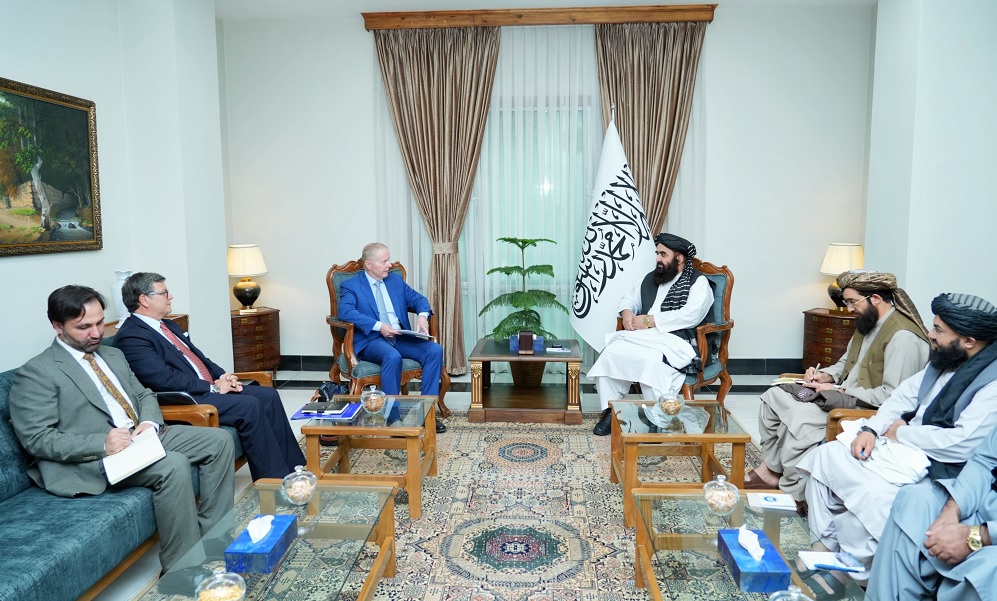
Amir Khan Muttaqi, foreign minister of the Islamic Emirate of Afghanistan (IEA), says the international community has failed to provide Afghan farmers with the necessary support for alternative livelihoods to sustain the country’s achievements in combating narcotics.
Afghanistan’s Ministry of Foreign Affairs said the issue was raised during Muttaqi’s meeting with Thomas Frellesen, the newly appointed European Union special envoy for Afghanistan.
According to a statement from the ministry, the two sides exchanged views on Afghanistan’s security situation, counter-narcotics efforts, and a range of humanitarian and political issues.
Frellesen acknowledged the IEA’s achievements in ensuring security and combating narcotics, saying that supporting security in Afghanistan and fighting drugs were part of the European Union’s official position.
He also assured Muttaqi that the EU would seek to expand cooperation with Afghanistan across various sectors.
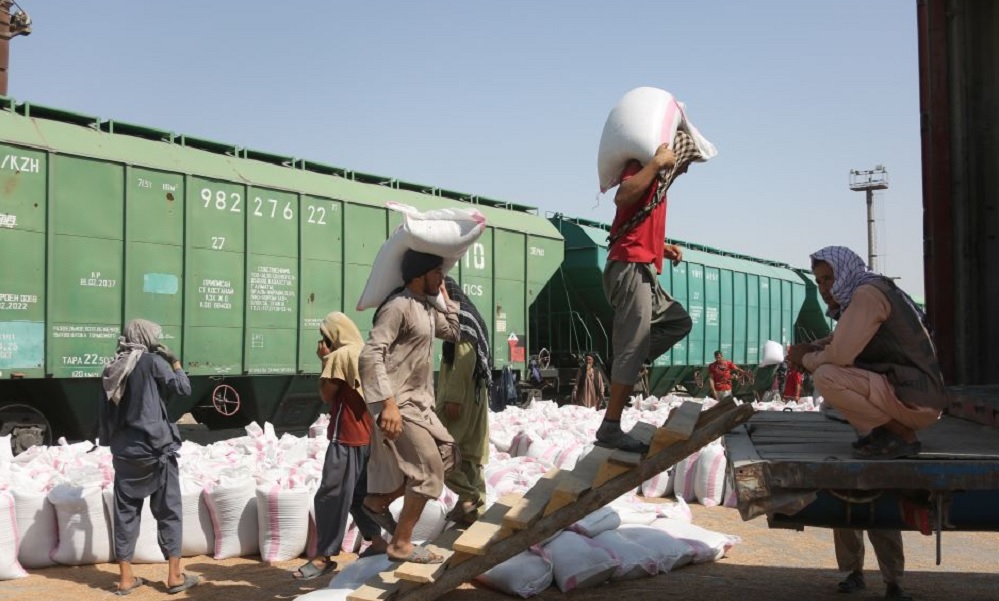
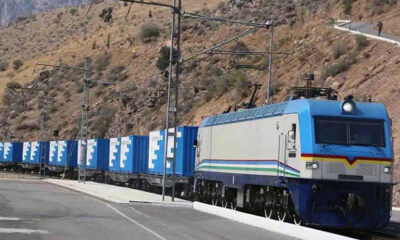
The Hairatan railway port in northern Afghanistan receives between 280 and 300 freight wagons daily from Central Asian countries, highlighting its growing role in connecting Afghanistan to regional and international markets.
The 75-kilometer Hairatan–Mazar-e-Sharif railway links Afghanistan with Uzbekistan and provides a key route for transporting goods from Central Asia, China and other international markets into the landlocked country.
Sayed Qadim Karimi, head of railway transportation at Hairatan port, told China’s Xinhua news agency that trade activity had increased this year, with an average of 280 to 300 wagons arriving at the port each day.
He said the railway transports a wide range of goods to Afghanistan, including clothing, medical equipment, machinery and electrical equipment, adding that trade with China had expanded in recent years.
Afghan traders say the railway connection has helped strengthen commercial ties with China and other regional countries while making it easier to transport imported goods.
“We transport our goods from China by freight train via Kazakhstan and Uzbekistan and receive them at Hairatan port,” businessman Ahmad Agha told Xinhua.
Agha said trade with Chinese businesses offered promising opportunities and expressed hope that further railway development would strengthen commercial ties with Kazakhstan, Russia and European countries.
He added that rising cargo volumes had created employment opportunities for local residents, with hundreds of workers handling containers at the port daily to support their families.
Another Afghan businessman, Ahmad Farid Fardan, who imports women’s clothing and colorful fabrics from China, said the railway connection had strengthened trade relations between the two countries.
Fardan expressed hope that expanding railway networks would help Afghanistan broaden its trade and economic relations with China and other countries in the region.
The railway’s role in China-Afghanistan trade dates back to 2016, when the first cargo train from China reached Hairatan as part of a pilot project. In 2019, Afghanistan sent its first export train to China, carrying several containers of talc powder.
The Hairatan railway remains an important transport link for Afghanistan’s import and export activities, offering access to regional markets and broader trade networks extending to Kazakhstan, Kyrgyzstan, Russia, China and Europe.
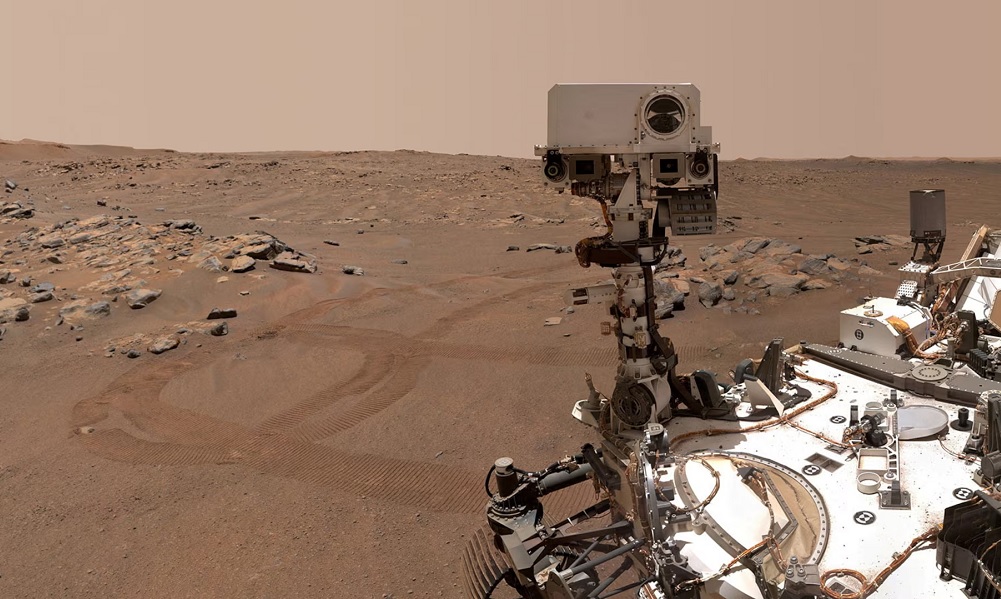
NASA’s robotic Perseverance rover has now driven farther than any other vehicle on the surface of any world other than Earth, racking up 28.1 miles (45.2 km) since arriving on Mars in 2021, the US space agency said on Tuesday.
The car-sized, six-wheeled rover reached the milestone 5-1/2 years into its mission to explore if conditions conducive to microbial life ever existed on Earth’s neighbor, Reuters reported.
In doing so, it is visiting some of the most ancient terrain ever encountered in the solar system.
“Perseverance’s engineering hardware and instruments are in excellent shape with all redundant systems still available,” Steven Lee of NASA’s Jet Propulsion Laboratory in California, told Reuters.
“A recent assessment of all systems concluded that they are capable of operating well into the 2030s, likely beyond,” added Lee, the project manager for NASA’s two Mars rovers, Perseverance and Curiosity.
Perseverance has exceeded the previous figure of 28.06 miles (45 km) driven on the Martian surface by NASA’s Opportunity rover from 2004 to 2018. Both also exceeded the driving distances of any lunar rover.
TRAVERSING JEZERO CRATER
Perseverance, with its suite of scientific instruments, has focused on the Jezero Crater, a region in the northern hemisphere of Mars believed to have been flooded with water and home to a lake basin billions of years ago.
The rover set the milestone in a journey toward an area called Idubi, through the region off the crater’s western rim nicknamed Lac de Charmes.
Its companion rover, Curiosity, rolls along in the Gale Crater near the Martian equator.
Perseverance is showing no signs of slowing down, Lee added.
Its mobility system mechanisms are being tested to show it can drive 100 km (62 miles) or more, he said, with the hardware to be tested to the equivalent of 150 km to 300 km (93 miles to 186 miles) in the effort.
NASA attributed a major role in Perseverance’s success to its self-driving capability, an autonomous navigation system called AutoNav. Lee said 90% of its drives are done autonomously, with no human intervention.
“Perseverance takes stereo images of the terrain ahead, generates a 3D software map, and selects the safest path towards a drive goal,” he said.
Another key component is the Vision Compute Element, a fast co-processor computer that allows the rover to process images and run its self-driving software very quickly, almost continuously during drives, Lee added.
That contrasts with previous rovers, which needed to pause to “think” before each drive segment, he said.
“Perseverance builds on the 29-year legacy of our past Mars rovers — Sojourner, Spirit, Opportunity and Curiosity — each incorporating prior lessons and improving our ability to drive on another world,” Lee said.
POTENTIAL BIOSIGNATURE
Lee said the rover’s biggest achievement was almost certainly its discovery, unveiled last year, of a potential biosignature, or possible sign of ancient microbial life.
This was found in reddish rock believed to have formed 3.2 billion to 3.8 billion years ago in a river channel feeding the lake that once filled Jezero Crater.
The Lac de Charmes terrain, Lee said, may yield clues to early planetary geological processes, such as the effects of large meteorite impacts. Jezero Crater was formed by such an impact early in Martian history.
Lee cited orbital evidence that some areas of the rim were once hydrothermal systems with warm or hot groundwater.
“These areas may once have provided a warm, watery subsurface environment conducive to life,” he added. “Indeed, some paleontologists hypothesize that life on Earth began in such environments.”
The rover’s original mission envisaged just 12.4 miles (20 km) of driving. NASA recently approved an extension of its mission to explore the crater rim until roughly the end of 2028.
The rover’s plutonium-based power system is performing as expected, Lee said, adding it has “many years of useful energy still available.”


Muttaqi tells EU envoy global community has failed to support alternative livelihoods for farmers

Hairatan railway port sees over 280 wagon arrivals daily from Central Asia

NASA’s Perseverance rover breaks record for off-planet driving on Mars

Russia warns against return of US military infrastructure to Afghanistan

Tahawol: Kabul’s criticism of Islamabad’s policy toward Afghanistan

Cricket Bonanza: Afghanistan set for packed international schedule

New warnings reignite debate over AI threat to humanity

UN warns of mounting humanitarian and human rights pressures in Afghanistan

Afghanistan faces cancer treatment crisis

Afghanistan says 28 killed, 32 captured in Nuristan operation
Tahawol: Kabul’s criticism of Islamabad’s policy toward Afghanistan

Saar: Pakistan deploying army in KP

Tahawol: EU appointing new envoy for Afghanistan

Saar: Pakistan’s political, security and economic crises

Saar: Ongoing expulsion of Afghan refugees from Iran and Pakistan discussed
-

 Regional4 days ago
Trump says US will not attack Iran before midterm elections in November
-
 Latest News3 days ago
Pakistan issues new directives for Afghan medical students and doctors
-
 Business5 days ago
Russia-Afghanistan trade surges 150% in first seven months of 2026
-

 World4 days ago
Witkoff, Kushner to meet Ukrainians for talks on the war, says US source
-

 Sport5 days ago
Arman FC defeat Istiqlal Kabul 3-2 in thrilling comeback
-

 Latest News3 days ago
Iranian lawmaker praises Afghanistan’s support, accuses Pakistan of ‘hypocrisy’
-

 Business5 days ago
Afghan products attract Saudi buyers at major food expo in Jeddah
-

 Latest News4 days ago
US senator cites Afghanistan visits in Pentagon ‘cover-up’ allegations over Iran war