
Regional
More than 65 missing, six dead after huge Karachi blaze
Karachi Mayor Murtaza Wahab told reporters at the scene that 65 people were still missing.

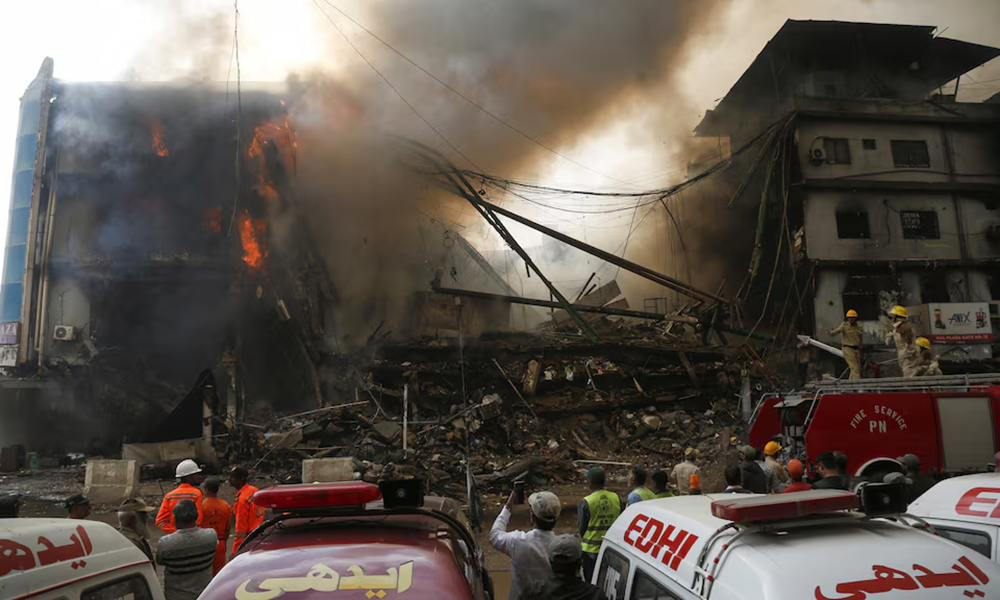
Firefighters in Karachi searched on Sunday for more than 65 missing people after a massive fire tore through a shopping mall in the historic downtown district, killing six and reducing parts of the building to rubble, Reuters reported.
Videos showed flames rising from the building as firefighters laboured through the night to stop the blaze, which started on Saturday night, from spreading in the dense business district. After fighting the flames for over 24 hours, firefighters began cooling the steaming rubble of the nearly collapsed structure.
Firefighters told Pakistan’s local television station Geo News that the lack of ventilation in the mall, which houses over 1,200 shops, caused the building to fill with smoke and slowed rescue efforts.
“It appears to have been caused by a circuit breaker,” Sindh police chief Javed Alam Odho told reporters at the site, according to Dawn News.
“The layout and construction of this market was such, and secondly, the nature of the items in it — such as carpets, blankets and other objects made of resins — so the fire is still simmering because of these.”
Karachi Mayor Murtaza Wahab told reporters at the scene that 65 people were still missing.
Rescue officials said six people had been killed and 20 others were wounded, read the report.
According to media reports, people chanted slogans criticising the mayor who came to the site after 23 hours.
Hundreds of people had gathered around the building, including distraught store owners whose businesses had turned to ash.
“We’ve been left high and dry, reduced to zero; 20 years of hard work, all gone,” shopowner Yasmeen Bano said.
The fire erupted on Saturday night, with rescue services receiving a call at 10:38 p.m. (1738 GMT) reporting that ground-floor shops at the multi-storey Gul Plaza shopping centre were ablaze.
“When we arrived, the fire from the ground floor had spread to the upper floors, and almost the entire building was already engulfed in flames,” Rescue 1122 spokesperson Hassanul Haseeb Khan told Reuters.
Images of the mall’s interior revealed the charred remains of stores and a bright orange glow as flames continued to rise throughout the building.
By Sunday evening, the blackened and broken metal frame of the building was strewn on the street alongside fallen air conditioners and some store signboards, Reuters reported.
Rescue workers said that parts of the building had started to collapse and that the whole structure could come down.






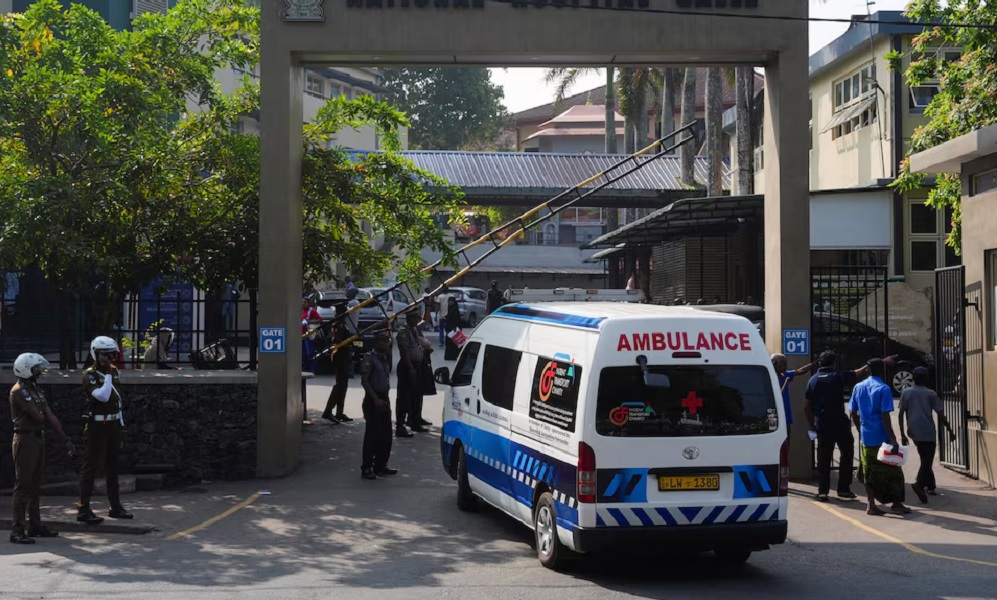
Iranian sailors rescued from a torpedo attack on an Iranian warship in the Indian Ocean are recovering in a hospital in southern Sri Lanka, officials said on Thursday, a day after the strike killed dozens of crew members and left many others missing.
Sri Lankan authorities said 32 sailors who survived the attack were taken to Karapitiya Teaching Hospital in the port city of Galle for treatment of injuries and exhaustion following the explosion and sinking of the vessel.
Hospital officials indicated that most of the survivors suffered relatively minor wounds and were expected to recover, Reuters reported.
The Iranian warship, identified by Sri Lankan officials as the frigate IRIS Dena, was sunk on Wednesday after being struck by a torpedo fired from a U.S. submarine in the Indian Ocean, roughly 40 nautical miles off Sri Lanka’s southern coast.
The incident occurred far from the main theatres of fighting between Iran, Israel and the United States, marking a dramatic widening of the conflict at sea.
Rescue teams responding to a distress call recovered at least 87 bodies from the water, while around 60 crew members remain missing from the roughly 180 people believed to have been aboard the ship.
Sri Lankan navy personnel reported finding survivors floating in the sea amid debris and oil slicks after the vessel sank.
U.S. Defense Secretary Pete Hegseth confirmed that an American submarine carried out the strike, saying the Iranian warship had been targeted with a torpedo while operating in international waters.
A video released by the Pentagon appeared to show a large explosion ripping through the rear of the vessel before it began to sink.
The IRIS Dena, commissioned in 2021, had recently participated in multinational naval exercises in India before beginning its return voyage to Iran when it was attacked.
Sri Lankan authorities said search operations for missing crew members are continuing in the waters south of the island.
The strike is one of the most significant naval incidents of the escalating confrontation involving Iran, the United States and Israel, extending hostilities into the wider Indian Ocean region.
Regional
Iran postpones Khamenei mourning ceremony amid Israeli threats
When Ayatollah Ruhollah Khomeini, founder of the Islamic Republic, died in 1989, an estimated 10 million people attended his funeral.
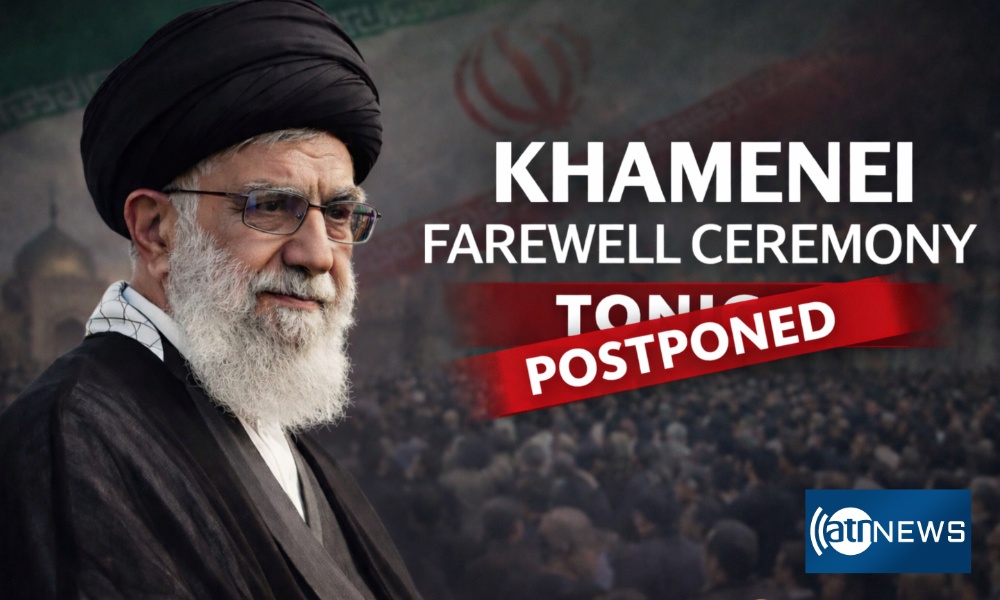
Iran has postponed a planned public mourning ceremony for Supreme Leader Ayatollah Ali Khamenei in Tehran, days after he was killed alongside several family members in joint US-Israeli air strikes.
State-affiliated Tasnim news agency reported that the delay was due to logistical challenges, including requests from people across multiple provinces who wish to attend. Analysts meanwhile stated security risks were also a consideration.
The ceremony had initially been scheduled to begin at 10pm local time at Tehran’s Imam Khomeini Prayer Hall and to continue over three days. Hojjatoleslam Mahmoudi, head of Iran’s Islamic Propagation Council, had earlier urged citizens to attend in large numbers to pay their respects.
Security concerns are however looming over the event. With millions expected to mourn, authorities face the risk of potential further attacks amid escalating hostilities between Iran, Israel and the United States.
When Ayatollah Ruhollah Khomeini, founder of the Islamic Republic, died in 1989, an estimated 10 million people attended his funeral.
Khamenei, 86, had served as Iran’s supreme leader since 1989, succeeding Khomeini after the 1979 revolution. As supreme leader, he held ultimate authority over the armed forces, judiciary and key state institutions, while serving as the country’s highest religious authority.
Attention has now shifted to the question of succession. Ayatollah Ahmad Khatami, a senior cleric and member of both the Guardian Council and the Assembly of Experts, said the process of selecting a new leader is nearing completion but acknowledged that the country remains in a “war situation.”
Under Iran’s constitution, the 88-member Assembly of Experts is responsible for appointing the supreme leader by simple majority vote. Candidates must be senior Islamic jurists with strong political judgment, administrative capability and religious credentials. Among those widely considered a leading contender is Khamenei’s second son, Mojtaba Khamenei.
Meanwhile, Israel’s Defence Minister warned that any successor who continues policies hostile to Israel would face the threat of assassination.
In a statement posted online on Wednesday, he said any future Iranian leader pursuing the destruction of Israel or threatening the United States and regional allies would be considered a target.
US President Donald Trump also commented publicly on Iran’s future leadership, saying the “worst-case scenario” would be another figure opposed to US interests.
Regional analysts say Iran’s political system has long prepared for the possibility of Khamenei’s death, with institutional structures designed to ensure continuity of command during crises.
Even so, the coming days are expected to be pivotal, as the country navigates both mass public mourning and a high-stakes transition of power under the shadow of war.
Regional
NATO condemns Iran’s targeting of Türkiye, reaffirms strong defense posture
Türkiye’s Defense Ministry reported that a ballistic projectile launched from Iran toward Turkish airspace was intercepted and destroyed by NATO air and missile defense units operating in the Eastern Mediterranean.
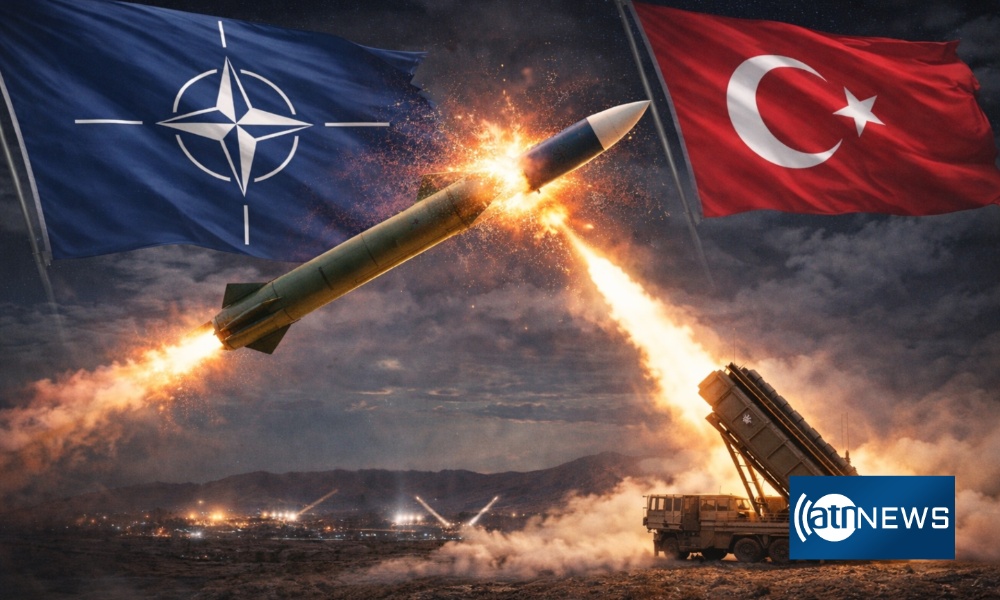
NATO on Wednesday strongly condemned Iran’s targeting of Türkiye and reiterated its firm commitment to defending all member states amid escalating regional tensions.
A NATO spokesperson said the alliance “stands firmly with all Allies, including Türkiye,” as Iran continues strikes across the region.
“Our deterrence and defense posture remains strong across all domains, including air and missile defense,” the spokesperson added, underscoring the alliance’s readiness to respond to threats.
Earlier, Türkiye’s Defense Ministry reported that a ballistic projectile launched from Iran toward Turkish airspace was intercepted and destroyed by NATO air and missile defense units operating in the Eastern Mediterranean.
According to the ministry, the munition was tracked after transiting Iraqi and Syrian airspace before being successfully neutralized.
The incident marks a further escalation in regional hostilities and highlights NATO’s heightened alert posture along its southeastern flank.


Tawsia: Impact of regional crisis on Afghan projects discussed

Russian foreign minister urges diplomatic solution to Kabul–Islamabad tensions

Afghans rally across provinces to condemn ongoing Pakistani airstrikes

Spread of war to Gulf nations condemnable, must be stopped: IEA FM

UN reports 185 civilian casualties in Afghanistan amid Pakistan clashes

Pakistani military jet downed in Afghanistan’s Jalalabad, pilot captured alive

Afghan Air Force conducts airstrikes in Islamabad, other cities

IEA releases three Pakistani soldiers to mark Ramadan

Afghanistan’s Chief of Armed Forces underscores readiness and equipment for national defense

Afghanistan welcomes investment and technology partnerships with India
Tawsia: Impact of regional crisis on Afghan projects discussed

Saar: Sixth day of US–Israel war with Iran reviewed

Tahawol: Discussion on ongoing US–Israel war with Iran

Saar: Turkiye’s efforts to revive ceasefire between Kabul-Islamabad

Tahawol: Discussion on ongoing conflicts between Afghanistan and Pakistan
-
 Latest News5 days ago
Afghan air force strikes key Pakistani military installations in retaliatory operation
-

 Regional5 days ago
Middle East conflict intensifies; UK base in Cyprus targeted
-

 Regional5 days ago
Ayatollah’s wife dies from injuries sustained in airstrike on Tehran residence
-
 Latest News3 days ago
Amir Khan Muttaqi, Zhao Xing discuss regional security and violations of Afghan territory
-
 Latest News4 days ago
UNAMA calls for immediate halt to Afghanistan–Pakistan cashes
-

 International Sports4 days ago
AFC postpones Champions League matches amid escalating Middle East tensions
-

 Business5 days ago
Afghanistan records 33% rise in railway cargo transport
-

 Regional4 days ago
US Embassy, Consulates in Pakistan suspend visa services over security concerns